
From Timber Rush to Treasured Canopy: The Trees of Avoca Beach
My first visit to Avoca Beach, in 2009, left a lasting impression. Here was a town rich in lush semi-tropical plants, shaded by numerous towering mature trees, a striking contrast to some of the towns I had driven through on my way down from Newcastle, where greenery had largely been replaced by concrete and Colorbond. How different, how special, Avoca seemed, as if the residents had taken care to settle themselves carefully among the majestic trees rather than bulldozing them down. Since moving here five years ago, I have come to appreciate those trees even more, not least for enabling the wonderfully diverse, and wonderfully noisy, birdlife we all enjoy.
But how did Avoca come to have such a magnificent tree canopy? The answer lies in a history that is both remarkable and, at times, sobering.
The History of Trees in Avoca
Prior to the arrival of European settlers on the Central Coast, the Darkinjung people lived for millennia amid dense forests of native trees, which provided their firewood, shelter and bush tucker. Their sustainable way of life, lived out in tune with nature, had little lasting impact on the forests.
All that was to change with the arrival of Europeans in the early 19th century. The land was hilly, densely forested and extremely time-consuming to clear, and it was not easily farmed. But there was an enormous demand for timber, and the forests were full of valuable trees including Turpentines, Sydney Blue Gums, Spotted Gums, Ironbarks, Blackbutt, Red Cedar and White Mahogany.
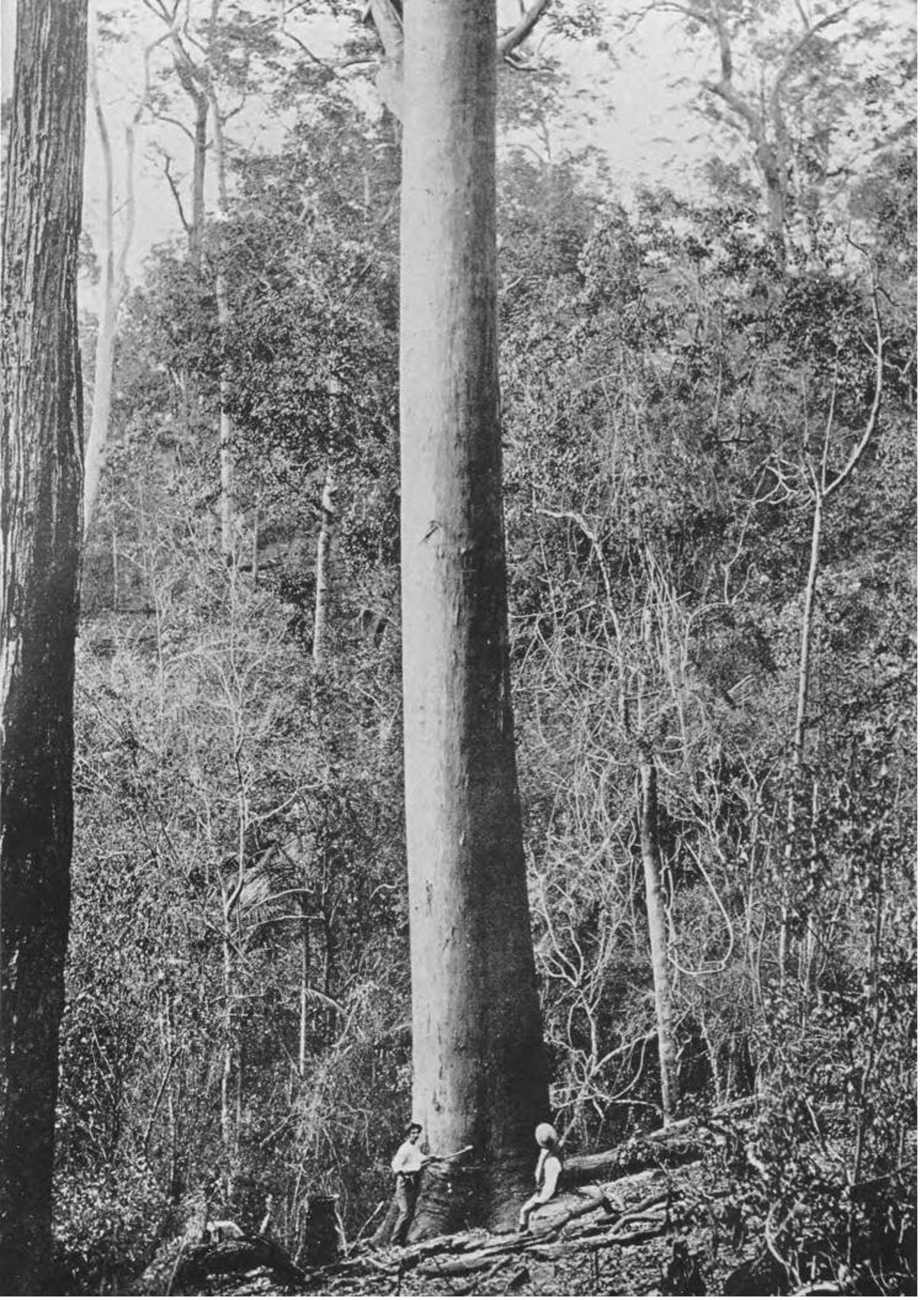
A magnificent Sydney Blue Gum (Wyong, 1903-10). Note the loggers dwarfed at the bottom.
The opening of the Great North Road in 1830, linking Sydney with Maitland, triggered a timber rush not unlike the gold rushes of the era. At its peak, roughly half of all Central Coast residents were employed in the industry, and records show there were nearly 80 sawmills operating across the region, including at Kincumber, Terrigal and Gosford. Trees felled around Avoca Lake were floated across the lagoon to what is now North Avoca, where they were hauled up the hill on a wooden tramway in carts pulled by teams of bullocks, bound for the sawmill at Terrigal Haven.
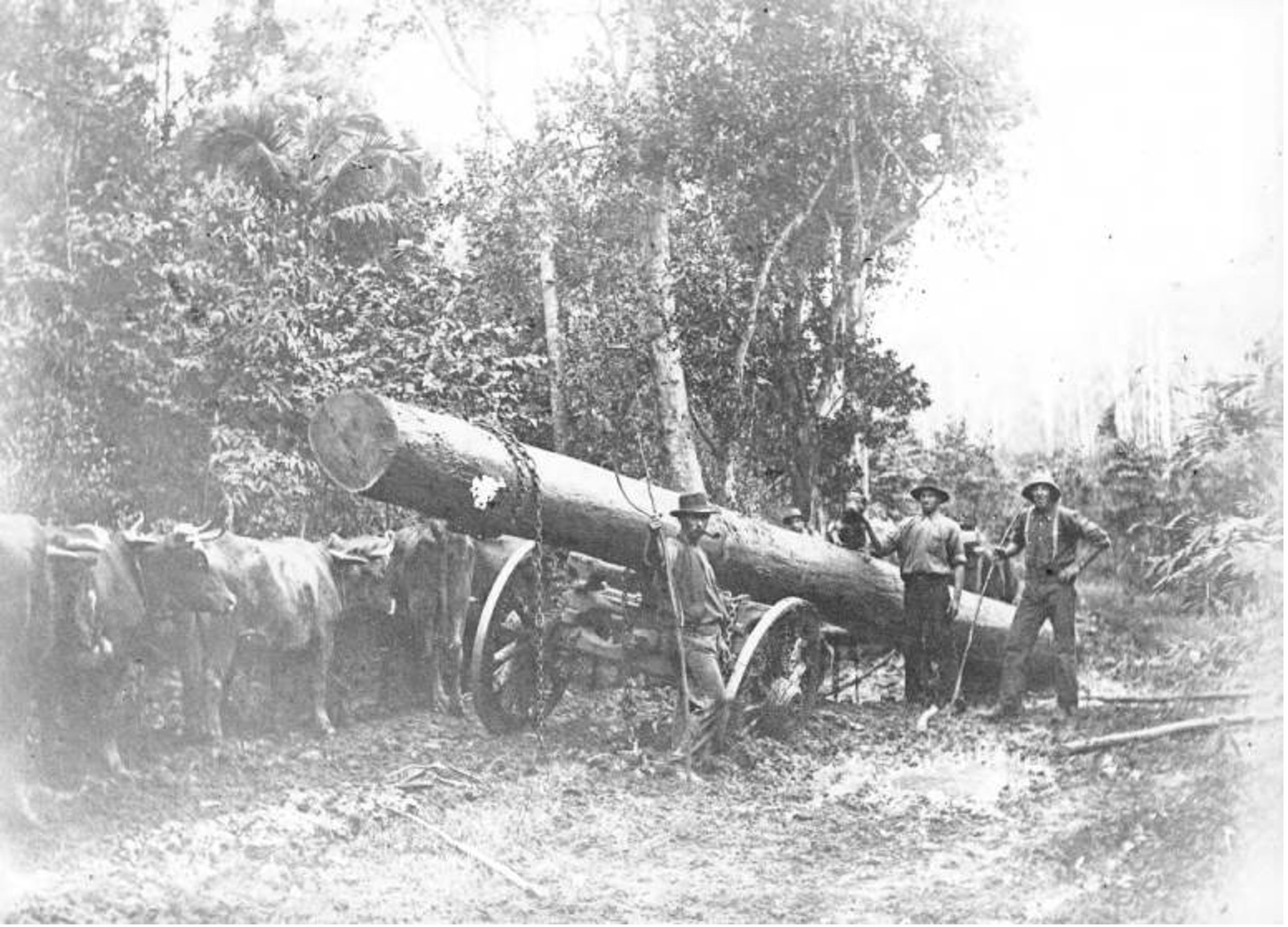
Bullock Wagon, stuck in the mud (Lisarow, unknown date)
Timber was cut into manageable sizes at the mills and transported to Sydney by boat, departing from the creeks at Narara, Erina, Wyong, and Mangrove, or sent to Maitland by dray. Later, once the railway reached the area in the late 19th century, trains took over much of that role.
The timber found many uses, both locally and further afield. In Australia it was primarily used for shipbuilding, roof shingles, walls, doors and furniture. Overseas, it was exported as railway sleepers to Canada, New Zealand, China, South Africa and Japan.
Not all the timber left the region. Some was used to build ships at the many boatbuilding businesses that flourished along the Coast throughout the 19th century. Over 500 boats were built on the Coast during this time, with shipyards at Davistown, Terrigal, Bensville and many other locations across the region.
The End of the Timber Rush
By the early 20th century, the rush was slowing to a crawl. The most accessible stands of valuable timber, mainly blackbutt and blue gum, had been largely exhausted, and the trees that remained were either of lower value or harder to reach. Improved road and rail connections opened up more of the country to timber extraction, gradually eroding the Central Coast's competitive advantage. Farming took over as the primary use of land in the region, and shifting community priorities saw more land protected as National Parks and Reserves, placing it beyond the reach of loggers.
The great forests that had once defined the Central Coast landscape had been dramatically thinned. What remained, however, quietly endured, and what we have today is, in a real sense, what survived.
The Present Day
Fast forward to the 21st century, and the Central Coast's trees are still vital assets, though the timber rush is long gone. It is estimated there are between 1.5 and 2 million trees on urban and non-bush land in the Central Coast. We now understand and appreciate the importance of the 'ecosystem services' trees provide: they generate the oxygen we breathe, stabilise the soil with their root systems, and help mitigate flooding and landslips. They provide food and shelter for birds, insects and other animals, regulate air temperature, and offer precious shade in the summer months.
There is also a strong economic case for protecting them. Tourism is one of the Central Coast's most significant industries, and millions of visitors come to the region each year - many of them to Avoca - drawn by the beauty of the natural environment. Visitors may not specifically cite trees as their reason for coming, but without them the region would be a far less attractive destination. Imagine what Avoca might look like if the trees were gone:
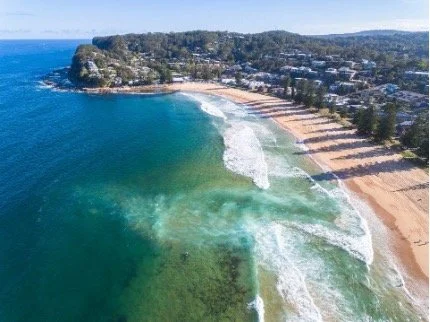
Before - Avoca Beach showing off its plentiful trees
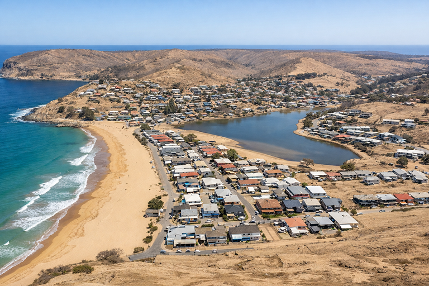
After - An impression of Avoca without trees (created by Artificial Intelligence). Would you want to come on holiday here?
How Trees are Protected
Fortunately, there are rules in place to protect the remaining mature trees on the Coast. Property owners cannot cut down mature trees on their property without express permission (unless they are within 3 metres of their house). The rules, designed to protect canopy cover, biodiversity and habitat, come from both local planning controls and NSW state law. The rules are complex but can be summarised as follows:
Most mature trees, even those of private property, are protected unless a specific exemption applies, for example, where a qualified arborist certifies that a tree poses an imminent risk to life or property, is genuinely dead or dying, or belongs to a species classified as undesirable. Blocked views, unwanted shade, leaf drop, or improved property value are not considered legitimate grounds for removal.
I asked the Council if they prosecute unauthorised tree removals, and discovered that they actively investigate many cases and have issued more than 100 fines over the past five years. They take action against anyone responsible, be they a home-owner, contractor or arborist. Fines vary but a recent prosecution resulted in a fine of $66,000 being imposed on the responsible person. Council asks that anyone who suspects that an unauthorised removal of a tree is imminent or is underway to contact the Customer Service Centre on 4306 7900 or submit an online customer request.
When Council itself is required to remove trees, for road widening or drainage works, for example, it has an informal policy of planting at least two replacement trees for every one removed, though not necessarily in the same location. It should be noted that this is an expectation rather than a formal policy and Council publishes no data to prove this is happening.
The trees of Avoca have endured a great deal over the past two centuries. That so many magnificent specimens still stand is something worth appreciating, and protecting.
__________________________________________________________________________
The following publications were consulted in writing this article, all available from Gosford Library (Local History section). Any factual errors or omissions are mine alone.
The Central Coast of New South Wales: Environment and People, Darrell G. Fisher, Hobbs and Hobbs, 1997.
Copacabana: A History 1896–1996, Lorraine Grunseit, Gosford Printing, 1996.
Terrigal: A History of the Area, Liz Parkinson, The Lazy Lizard Publishers, Terrigal, 2009.
The Timber Industry of the Central Coast of NSW, Darrell G. Fisher, Hobbs and Hobbs Publishing, Gosford, 1998.
Photos: Central Coast Memories: https://centralcoast.contentdm.oclc.org/